Loading stories…Inapakia habari…
Loading stories…Inapakia habari…

By Habari Huru Civic Lab · Habari Huru Civic Lab · April 22, 2026
Sisi ni nani? Who is this law for?
If you have ever gone to a government office and been told a tender went to the PS's cousin's company, or watched a county official award a road contract to a business they secretly own, this law was written for you. Not for lawyers. Not for boardrooms. For you.
The Conflict of Interest Act, 2025, is Kenya's answer to one of the oldest forms of corruption: public officers using their positions to benefit themselves, their families, or their friends at the expense of the rest of us.
"It is unacceptable for the Houses of Parliament to deny the nation a much-needed instrument in the war on corruption."
What exactly is a conflict of interest?
In simple terms, it is when a person in a public job makes decisions that benefit themselves, their spouse, their children, or businesses they are connected to, instead of serving the public.
For example:
These scenarios are now explicitly illegal under the new law.

The long road to this law
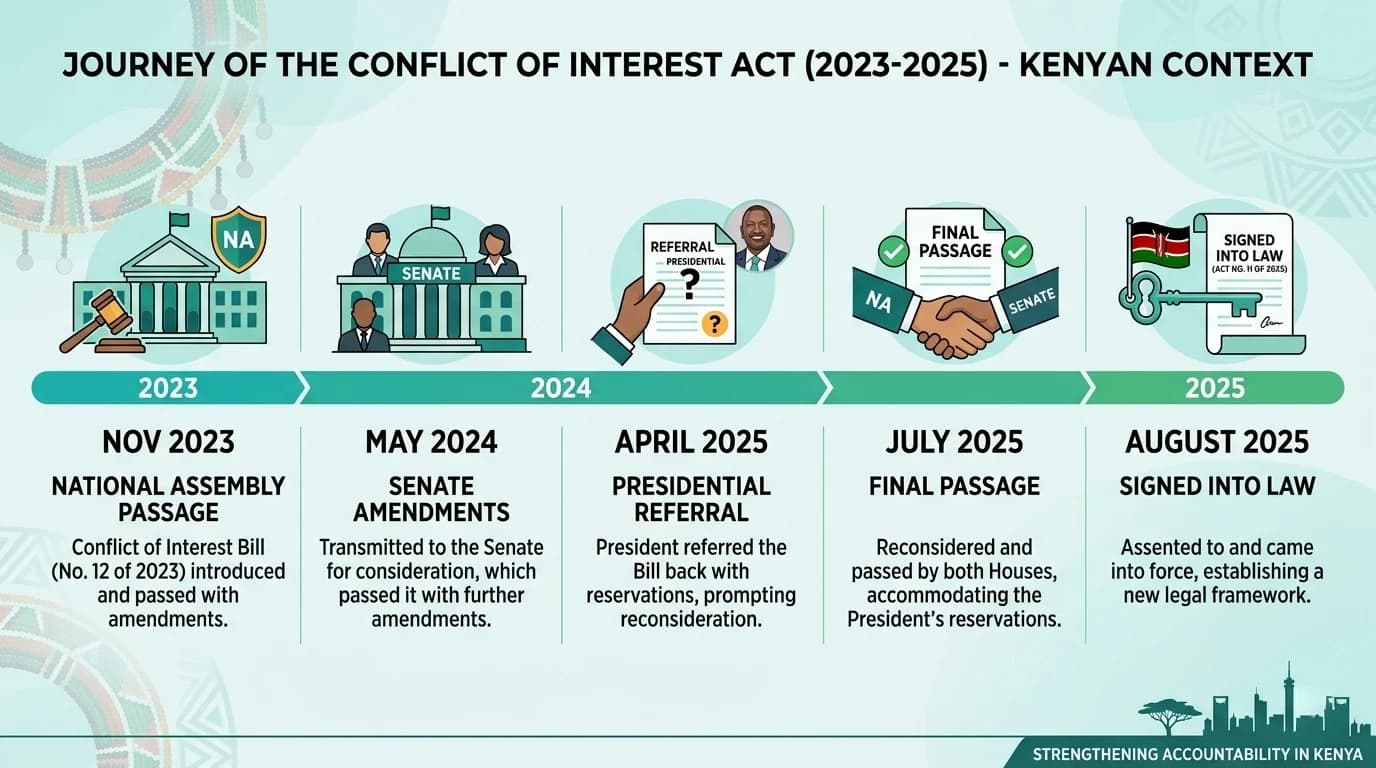
This did not happen overnight. The journey began in 2023 when the National Assembly passed the original bill, but disagreements between the National Assembly and the Senate over key provisions stalled it for nearly two years.
The National Assembly first passed it in November 2023. The Senate passed it with amendments in May 2024. Then came a mediation committee. Then, President Ruto referred it back to Parliament in April 2025, calling the provisions too weak. Finally, both Houses agreed on a stronger version passed in June and July 2025, and the President signed it into law on 30 July 2025, with the law coming into force on 19 August 2025.
What does the law actually do?
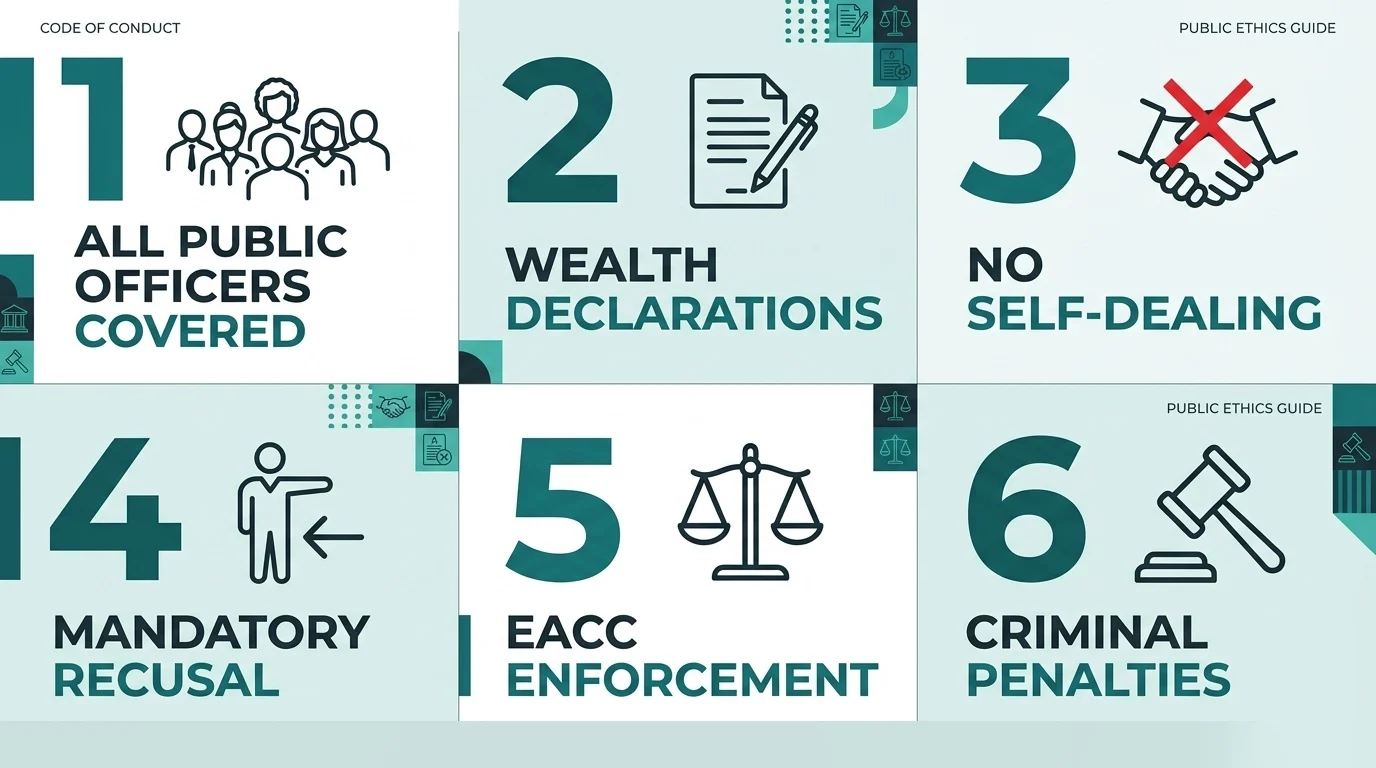
1. It names who must comply
The law covers ALL public officers, and crucially, it now includes people who were previously left out: the Chief Justice, Cabinet Secretaries, Members of County Assemblies, and county officials. No one in public service is exempt.
and their family's wealth
Every public officer must now declare their income, assets, and liabilities — including those of their spouse and dependent children — every two years. The declarations are supervised by the Ethics and Anti-Corruption Commission (EACC). Hiding assets is now a criminal offence.
A public officer cannot be a party to or benefit from a contract with the institution they work for. If a government department you oversee is buying goods or services, you cannot secretly profit from that deal.
Mandatory recusal: if a public officer has a personal interest in a decision being made at their office, they must formally remove themselves from that decision. They cannot sit in a meeting where their private business is being discussed.
The Ethics and Anti-Corruption Commission now has the power to investigate violations, suspend implicated officers during investigations, and refer cases for criminal prosecution. Investigations must be completed within 90 days.
The Act criminalises conduct that in many other countries would only attract administrative penalties. Violators face heavy fines and imprisonment. Kenya's approach is deliberately punitive compared to similar laws in Canada, the UK, or South Africa.
The law places obligations primarily on public officers and their families. But it also matters for businesses. If your company does business with the government, supplying goods, providing services, or entering public-private partnerships, you now have legal exposure if you knowingly involve a conflicted public officer in the deal.
Ultimately, the law is meant to protect ordinary Kenyans — the wananchi who depend on government services being delivered fairly, on public contracts going to the most qualified supplier, and on public money being spent on public needs.
"You now have levers to make sure that you protect the resources of the Republic of Kenya and hold every officer to account."
The World Bank connection, why donors cared
This was not just a domestic governance matter. Kenya's passage of the Act was a condition tied to the release of a major World Bank funding tranche worth billions of shillings in budget support. The World Bank had withheld disbursement while the bill remained stuck.
The link to ordinary life: without that funding, the government faces greater fiscal pressure, which ultimately leads to higher taxes, reduced public services, or more expensive borrowing — all of which affect the cost of living for everyday Kenyans.

Not everyone was satisfied. Transparency International Kenya, which submitted a memorandum during the public participation stage, raised a concern worth noting: the old law, the Public Officer Ethics Act, covered a wider range of public officers' conduct, not just conflicts of interest. By repealing it entirely, some important ethics provisions may have been lost.
"The Public Officer Ethics Act covers a broad range of issues about the ethics of public officers, with conflict of interest being only one of them."
This is a legitimate concern. The new law is stronger on conflict of interest specifically, but it is worth watching whether any gaps in broader ethics coverage emerge in practice.
The law is on paper. Whether it works depends entirely on enforcement. Kenya has had ethics legislation before; the Public Officer Ethics Act of 2003 existed for over two decades with limited impact. What is different this time is a clearer mandate for the EACC, a broader definition of who is covered, and stiffer criminal penalties.
But laws do not enforce themselves. The EACC's budget, independence, and political will to pursue powerful individuals will be the real test. As citizens, your role is to know this law exists, to make complaints when you see public officers benefiting from decisions they should not be making, and to hold the EACC accountable for following through.

Sourced corrections and on-the-ground replies, not open debate.
No evidence replies yet.
Context from neighbors. Trusted neighbors are verified or county stewards.
Discussion
Conversation and debate, opens after you have read most of the story, or tap below.
0 comments